The Effect of Federal Agencies’ Procedures on Public Opinion and Behavior
I examine how US federal agencies can manage their image among the public. I suggest that people evaluate the fairness of behaviors during a public meeting to determine agency legitimacy and further translate beliefs about legitimacy to collaborative actions with the agency.
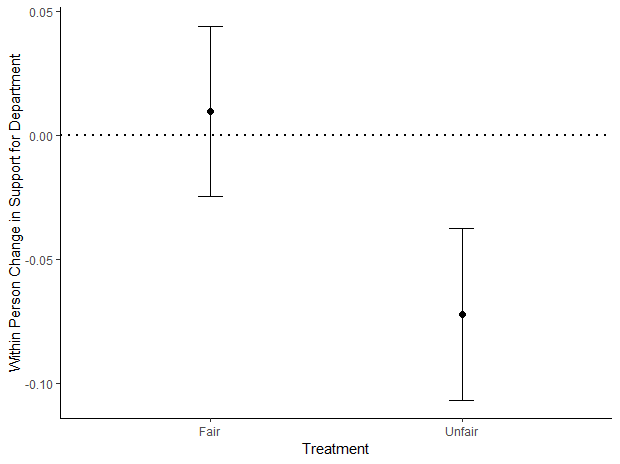
Results from an original vignette survey experiment indicate that learning about agency behaviors only deleteriously contributes to legitimacy evaluations but that beliefs about legitimacy positively predict willingness to cooperate with and empower the agency.
Collectively, the findings suggest that fair procedures do not ultimately motivate the public to act collaboratively with agencies. Should agencies seek to improve their standing with the public, they must identify relevant qualities or behaviors that contribute to positive assessments.
Client and Public Attitudes toward Federal Agencies and Bureaucracy
The systematic ability of client relationships with federal agencies to educate both clients and the public about agencies as political organizations is unclear beyond the distributive welfare context. I suggest that the unique and concrete information acquired via interactions should intensify evaluations and that positive experiences beget support for the agency.
I find that client experiences do not consistently relate to the intensity or quality of attitudes toward agencies; abstract evaluations of performance, however, do. Perceptions of one’s client agency further translate to support for the bureaucracy. The plot below shows the predicted probability of favorability toward an agencies with which a respondent has an assumed or real experience. Experience quality predicts favorability in each case with the exception of real experiences when accounting for affect toward the agency.
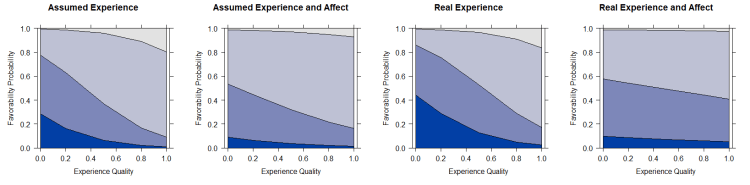
The results offer insights for bureaucratic accountability and performance as agencies aim to manage this dimension of reputation.
Political Influences of Public Attitudes toward Federal Agencies
Do Americans have opinions about federal agencies, and if so, are attitudes systematically constrained by political factors? Because bureaucratic politics are relatively low-salience and individuals hold little specific knowledge with which to evaluate agencies, I argue that individuals rely on agency-adjacent political information to form their attitudes.
Using nationally representative surveys administered from 2007 to 2018, I find that individuals rely on political information to evaluate agencies. The plot below shows the linear regression estimates of predictors in each column on support for the corrresponding agency. Copartisanship with the president and one’s ideology, and to a lesser extent partisanship, influence attitudes toward agencies; this effect persists over time but varies by agency.
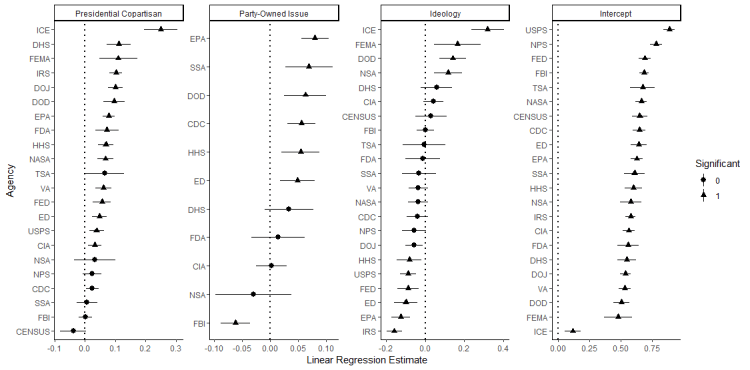
Further, institutional commitment to the bureaucracy suffers when support for agencies is low, but even the most sour assessment of agencies coincide with bureaucratic support.
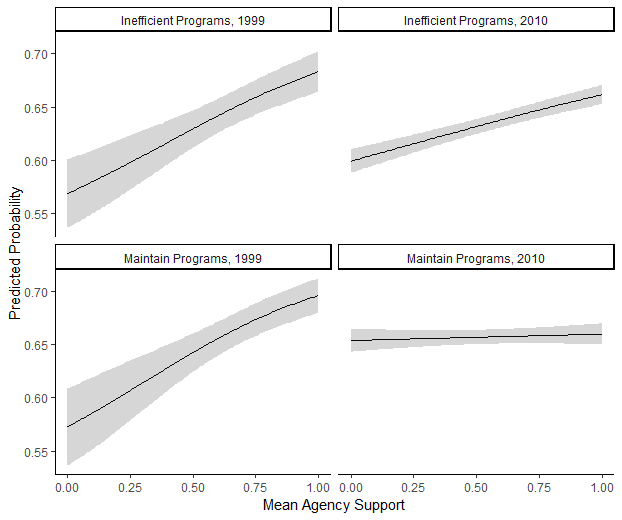
The plot to the left provides the predicted probability of respondents claiming agencies programs are ineffecient, rather than the government having the wrong priorities (top row) and that agency programs should be maintained, rather than defunded (bottom row).
I provide evidence that public opinion of agencies depends political factors independent of agencies and that these attitudes impact broader support for the federal bureaucracy as an institution.
Public Interest Group Lobbying Strategies During Notice and Comment Rulemaking
Public interest groups organize and lobby to influence policy, but are constrained by their need for organizational maintenance. However, we know relatively little about how these competing goals impact public interest group lobbying during notice and comment rulemaking and by extension groups’ ability to influence policy.
I explore the relationship between the issue salience of an agency rule and public interest groups’ lobbying behavior. I suggest that public interest groups are less likely to lobby to influence policy when issue salience is high, but are more likely to lobby for organizational maintenance as issue salience increases. Using comments on 35 rules finalized by the Environmental Protection Agency from 2005 to 2015, I find partial evidence for the former relationship and support for the latter. The results also indicate that less complex rules lend to public interest group lobbying for organizational maintenance.
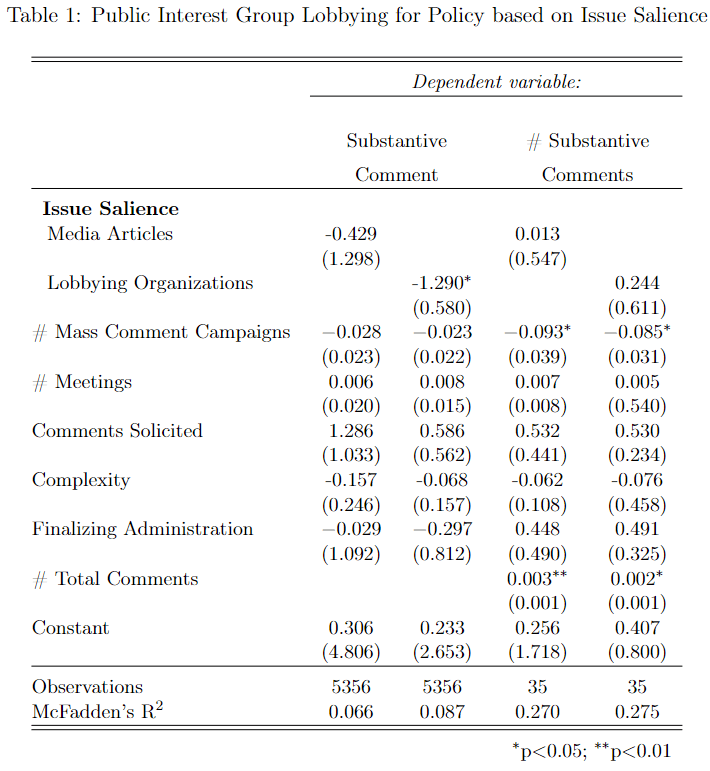
The first two columns of the table to the left provides inconsistent results about the effect of salience on public interest groups’ lobbying to pursue their preferred policy. The second column indicates that interest groups are less likely to submit a substantive comment on an agency rule as the number of organizations lobbying on the rule increases. This finding runs counter to the claim that lobbying begets lobbying.
The table to the right demonstrates the relationship between issue salience and interest groups lobbying to maintain their organization. When issues are more salient, public interest groups submit more mass comment campaigns on a rule. This suggests that public interest groups lobby to show their political power to their members and agencies.

My findings support the premise that multiple goals constrain public interest group lobbying behavior.
 Zoe Ang, PhD